
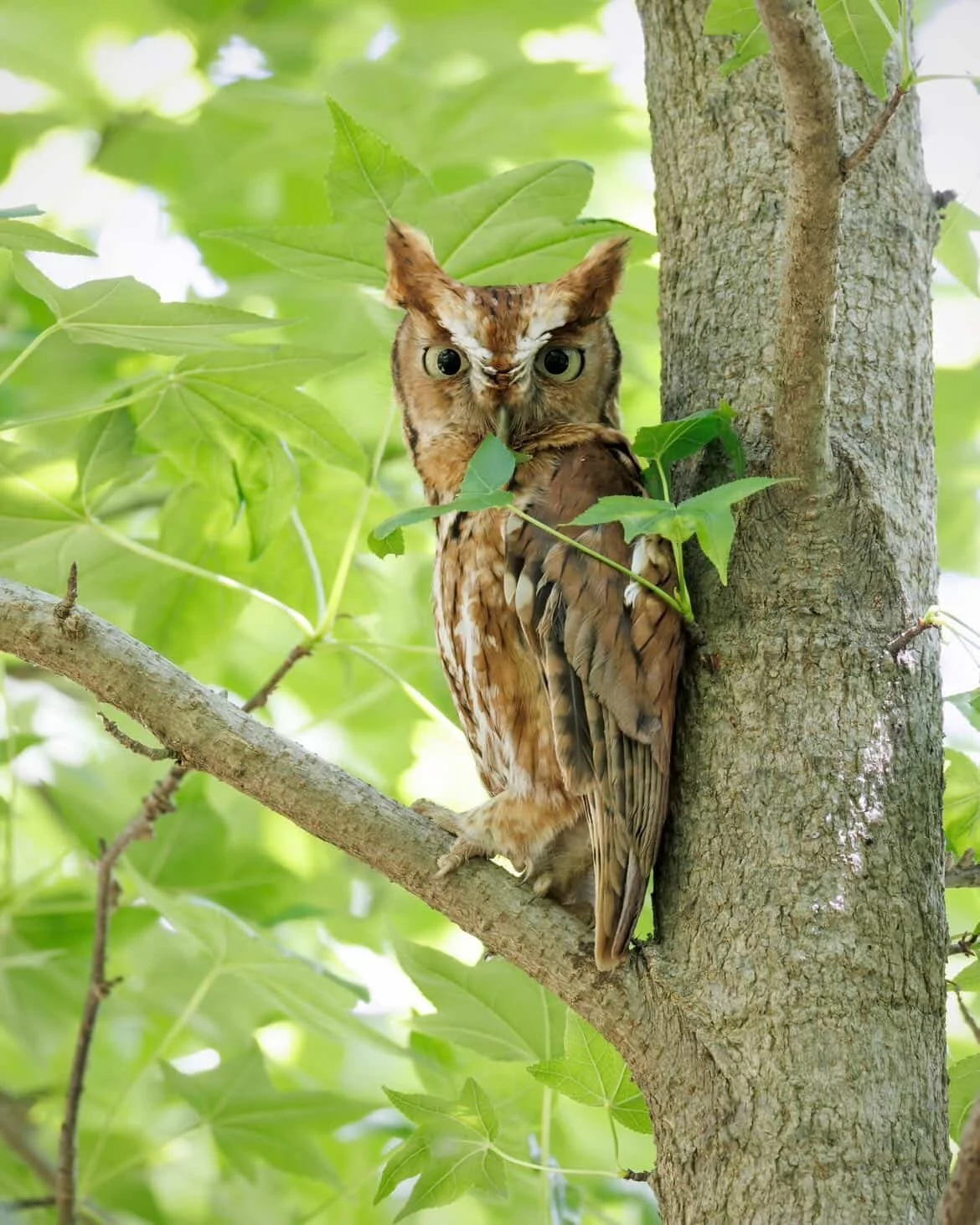
Eastern Screech Owls are tiny little things, about 8½ inches long, weighing less than a half a pound. For the last 4 years, I have volunteered to monitor screech owl next boxes at Harris Lake County Park, so I’ve become more familiar and more enamored with them! I’ve seen grey and red morphs in the park, but more red feathered individuals than gray. They sport tiny ear tufts to assist with camouflage and shine bright yellow eyes. Eastern Screech Owls range from the Atlantic Coast west to the Rockies and north up along the Canadian border. They are rarely seen or heard as they are most active at night, but it doesn’t mean they aren’t sharing our human spaces with us. In fact, they do so quite successfully!
Habitat loss is the greatest threat to all bird species and the screech owl is no exception. When we fell trees, we remove nesting cavities, perches and shade. The changing landscape means food sources aren’t as abundant. The same is true when we farm over grasslands. And when we treat our homes with pesticides, we poison the whole food web.
In general, screech owls are not picky eaters. I have found moth wings, the remains of large frogs and song bird feathers in the nest boxes alongside the nurtured eggs and sleeping mama owls. Screech owls can catch birds and bats out of the sky. They pounce on small mammals and amphibians from perches 6-10 feet high. They are small but mighty hunters.
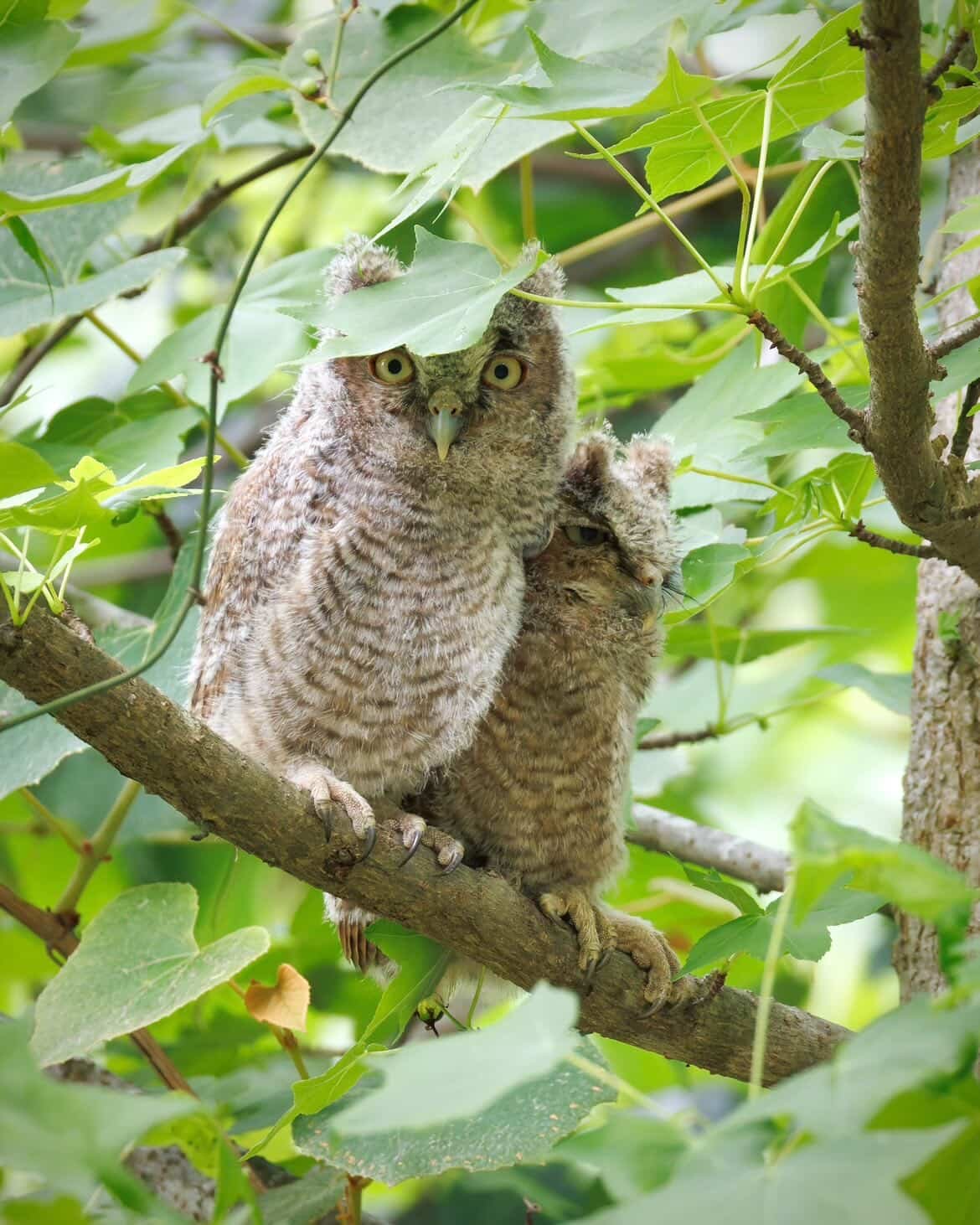
Spring 2026: Pictured here are the oldest two screech owl fledglings from one of the two successful owl boxes I monitored this season. They were spotted on a tree limb near the nest. Screech owls leave the nest around 28 days after hatching but stay close to their parents who help them hunt for the next 8-10 weeks. Photo Credit: Michael Fogleman
They nest in late winter to late spring, relying on existing tree cavities or nest boxes as shelter. The mated pair of adults do not build a nest nor do they modify existing cavities. The female will lay between 2 and 4 eggs, one egg per day. She stays on her eggs nearly 24 hours a day with only short breaks at dawn and dusk. Her partner brings her food which she will divvy to her offspring once they hatch. Her eggs will hatch in the order she laid them. They fledge in the same order. Many bird species will all hatch with their siblings, within hours of each other but not screech owls.
On top of the existing troubles to these beautiful birds, climate change threatens to upend the survival of screech owls. Greenhouse gas emissions from our human use of fossil fuels is peaking, causing the rapid warming of our atmosphere. Every living thing on our planet is forced to adapt. Some won’t be able to and as a result, we are presently witnessing a massive loss in biodiversity coined the Sixth Mass Extinction, at the hands of humans. Screech owls, thus far, have proven quite adaptable, thankfully.
Overall population numbers of the Eastern Screech Owl have declined in recent decades, however scientists admit that tracking owl populations is especially challenging due to their nocturnal nature. Since screech owls tend to be less picky about their nesting cavities than other birds and they tend toward any food source small enough to catch and carry, their flexibility is proving a benefit to species survival. They also seem to tolerate humans and the chaotic noises we produce fairly well. Their color adaptations from red to brown to gray also improve survivability as habitats change.
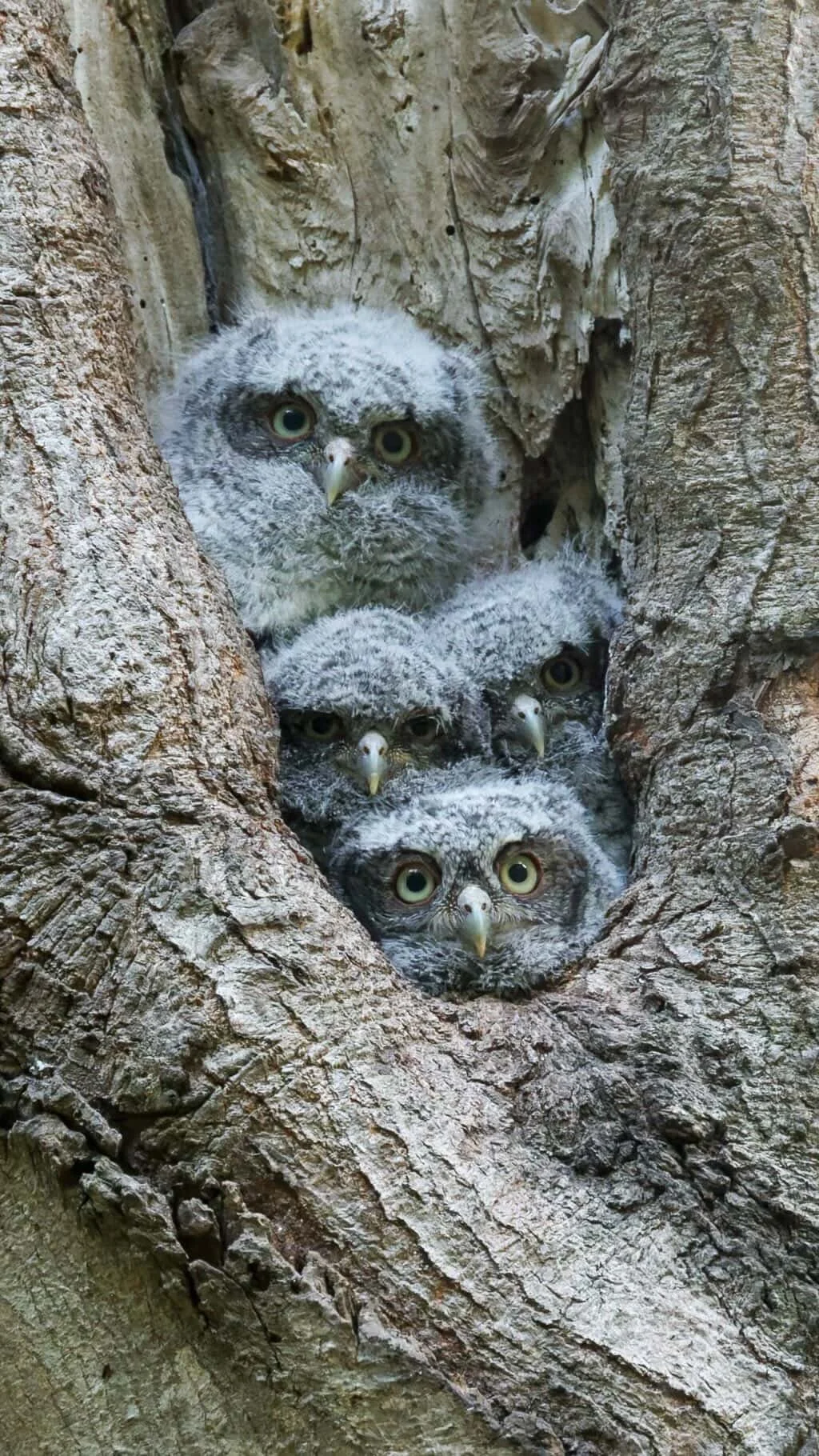
Four young screech owls peeking out of a natural tree cavity. Owls grow their fuzzy downy feathers first providing warmth during development. Their flight and contour feathers grow in later. Photo Credit: Michael Fogleman
But please don’t be lulled into complacency. Advocating for ample tree cover throughout urban areas is required for their continued survival. Leaving connected tracts of land that open to parks like Harris Lake County Park is required. We need to acknowledge the threat of rampant pesticide use on all species. Poisoning the mouse poisons its predator too. And quite frankly, our human bodies as well. Leave dead trees on your property if they don’t threaten your safety. Plant native plants to support wildlife at every level of the food web. Host a nest box on your property or help fund nest boxes at a park near you. Be a lazy gardener. Leave the leaves and the sticks as they support habitat for small critters that sustain nesting screech owls.
If you’d like to learn more about owls in general, I recommend the book “What An Owl Knows” by Jennifer Ackerman. I want to thank Joanne St. Clair at Harris Lake County Park for allowing me to volunteer for the nest box program year after year. I’m so proud of your stewardship of the park. And I want to thank Michael Fogleman for the beautiful photos he’s permitted me to use and for teaching me more about screech owls.